
The Salt Deception: Hidden Sugar, China Imports, and Why Your Table Salt Is Toxic

Updated: Aug 20
Salt is one of the most essential minerals human beings consume daily. It regulates nerve impulses, maintains fluid balance, and fuels basic cellular functions. But if you walk into almost any grocery store or restaurant, the white shaker on the table is far from pure mineral salt.
From hidden sugars in standard white salt to mystery additives in cheap imported pink salts, the salt market is full of deceptive processing.
Here is the truth about what is lurking in standard table salt, why hidden dextrose poses a real risk to blood sugar management, and why unrefined ancient salt harvested right here in the U.S. is the ultimate upgrade.
1. Morton’s Table Salt: Why Is There Sugar in Your Salt?
When you buy standard iodine-fortified table salt—like the classic blue container of Morton’s—you assume the only ingredient inside is sodium chloride.
If you turn that blue container around and read the fine print on the ingredient label, you will see three things:
Salt (Sodium Chloride)
Calcium Silicate (An anti-caking chemical agent)
Dextrose (A refined corn-derived sugar)
Why Is Dextrose in Salt?
Manufacturers add dextrose (a high-glycemic sugar) as a stabilizing agent to prevent the added potassium iodide from oxidizing and turning yellow or smelling foul over time. To hide the discoloration caused by processing, they use sugar to keep the salt looking bright white.
The Danger for Diabetics (Type 1 & Type 2)
While manufacturers claim the amount of dextrose is minimal, sugar in salt is a hidden trap:
Invisible Spikes: People living with Type 1 or Type 2 diabetes stringently monitor their carbohydrate intake. When blood sugar mysteriously creeps up despite careful meal tracking, hidden additives in basic seasonings are often the hidden culprit.
Accumulated Intake: Salt is used on nearly everything—from home-cooked meals to pre-seasoned meats. Eating dextrose-laced salt multiple times a day introduces unwanted, highly bioavailable glucose directly into your bloodstream without your knowledge.
2. The Commercial Processing Trap: Bleach and Anti-Caking Agents
To turn raw mined salt into uniform, bright white table salt, industrial processors put it through extreme chemical refinement:
High-Heat Stripping: Raw salt is heated to over 1,200°F (650°C), which strips away virtually all naturally occurring trace minerals (like magnesium, potassium, and calcium), leaving behind pure, harsh sodium chloride.
Chemical Bleaching: The salt is bleached with chemicals to give it an unnaturally stark white appearance.
Anti-Caking Chemicals: Aluminum silicate, sodium ferrocyanide, or calcium silicate are added so the salt flows freely out of shakers without clumping in humidity.
3. The Pink Salt Craze: Industrial Imports and Heavy Metals
In recent years, millions of health-conscious consumers swapped white table salt for imported Himalayan Pink Salt. But popularity created a massive grey market for cheap, low-grade imports.
Heavy Importation from Overseas: Much of the budget "pink salt" sold in mass retail stores is imported in bulk from international industrial mines (including Pakistan and processing centers in China).
Quality & Contamination Issues: Unregulated, low-cost imported salts often lack strict third-party testing. Independent laboratory tests on budget imported pink salts have revealed variable trace amounts of insoluble heavy metals, industrial dust, and microplastics depending on the quarry source and packaging facility.
Mystique vs. Reality: Just because salt is dyed or naturally pink doesn’t automatically mean it is pure or harvested under clean, ethical conditions.
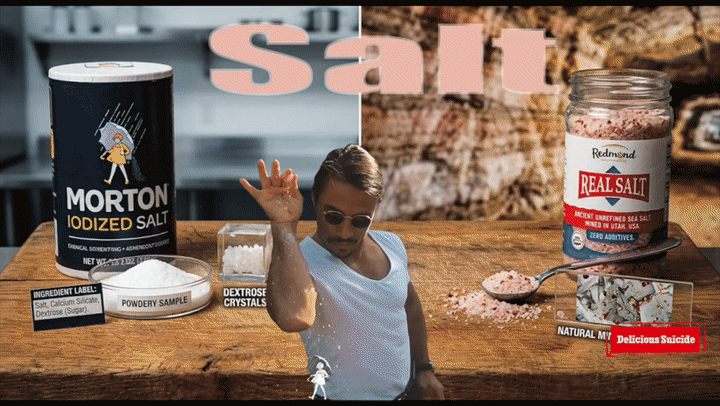
4. The Real Solution: Redmond Real Salt (Mined in Utah)
If you want clean, unrefined, nutrient-rich salt without hidden sugars or international import contamination, Redmond Real Salt (harvested out of Redmond, Utah) sets the standard.
1. Ancient Underground Seabed (100% USA Sourced)
Redmond Real Salt is extracted from an ancient underground seabed located deep beneath the Earth's surface in Utah. Protected by natural rock layers long before modern industrial pollution, microplastics, or ocean toxins existed, it is completely pure and unpolluted.
2. Zero Additives or Hidden Sugars
No Dextrose / No Sugars: 100% free of sugar, stabilizing chemicals, or artificial iodine additives.
No Chemical Bleaching: Never heat-treated, bleached, or chemically processed.
No Anti-Caking Agents: Contains zero aluminum silicate or chemical flowing agents.
3. 60+ Natural Trace Minerals
Because it is totally unrefined, Redmond Real Salt retains over 60 natural trace minerals—including potassium, magnesium, calcium, sulfur, and iron. These natural minerals give the salt its subtle flecks of red, pink, and gold, providing a smooth, complex flavor profile that elevates food without harsh chemical bitterness
5. Quick Salt Comparison Guide
Feature | Morton / Standard Table Salt | Cheap Imported Pink Salt | Redmond Real Salt (Utah) |
Origin | Industrial Refineries | Overseas Industrial Mines | Ancient Underground Seabed (Utah, USA) |
Hidden Dextrose (Sugar) | YES (Used to stabilize iodine) | No | NO (100% Pure) |
Chemical Bleach & Heat | YES (Heated to 1,200°F) | Varies by processor | NO (Unrefined & Natural) |
Anti-Caking Agents | YES (Calcium/Aluminum silicate) | Varies | NO (Zero Chemicals) |
Trace Minerals | Stripped (Pure Sodium Chloride) | Contains trace minerals (Varies) | 60+ Active Natural Trace Minerals |

The Bottom Line
Salt should nourish your body, not sneak refined corn sugar into your system or load your cells with anti-caking chemicals.
If you are managing blood sugar, battling systemic inflammation, or simply trying to feed your family clean food, throw out the processed white shakers and questionable cheap imports. Stick with unrefined, natural mineral salt like Redmond Real Salt—pure, American-harvested, and completely free of hidden additives.
Side Note: Being fair Morton has stated
Blood Sugar Impact: Because a typical pinch or serving of salt is around 1 gram, the amount of dextrose ingested is roughly 0.4 milligrams. For context, a single gram of carbs is 1,000 milligrams, so trace amounts in salt won't physically trigger a blood sugar spike or register on a continuous glucose monitor (CGM). But let's remember they told us that after we found out. So I don't trust them



Comments